

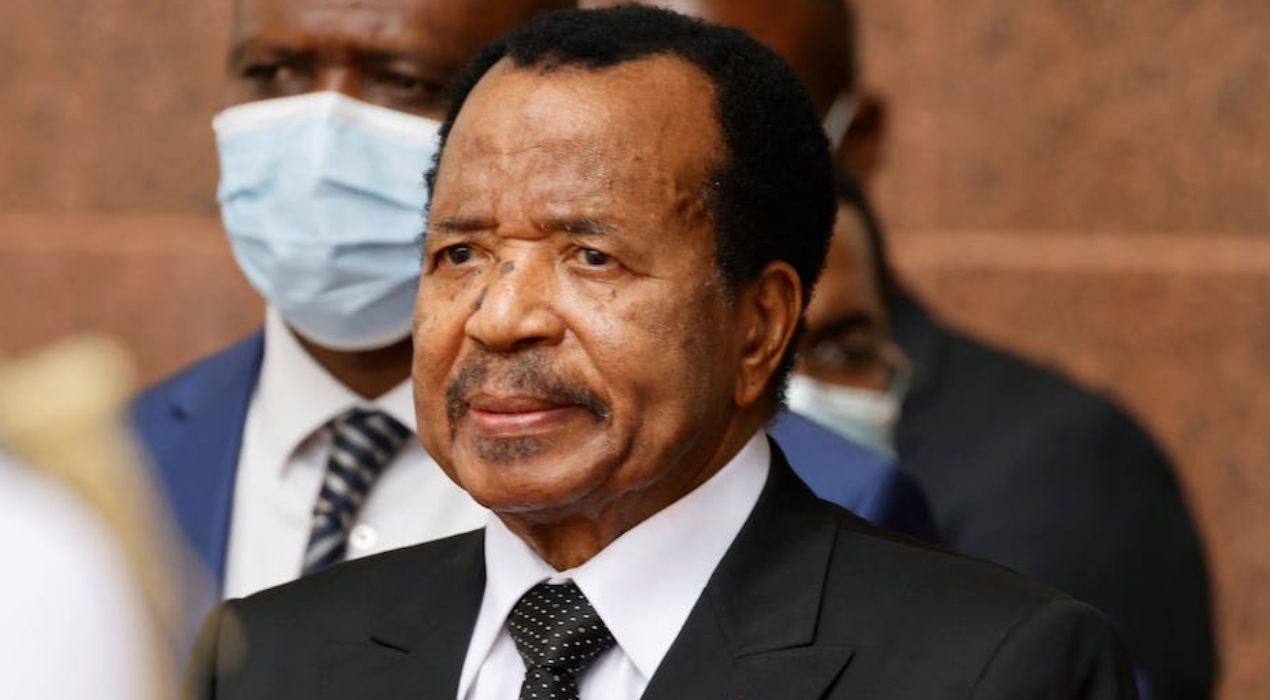
Cameroon’s President Paul Biya has now spent 50 consecutive days outside the country, triggering growing political uncertainty and renewed debate over the state of governance in the Central African nation.
The 93-year-old president left Cameroon on June 7 with his wife for what was officially described as a private stay in Europe. Since then, his prolonged absence has become a major political issue, with opposition leaders, legal experts and sections of the public questioning the functioning of the state.
The Douala-based newspaper Le Messager described the situation as deeply worrying, arguing that Biya has left behind “a country at a standstill, a powerless government and a population living in uncertainty.”
According to Actu Cameroun, presidential activity during the 50-day period has largely been limited to the signing of a few military decrees and the sending of official telegrams. The absence has fueled speculation in Yaoundé, with rumours, fake presidential decrees circulating on social media and increasing calls from the opposition for greater transparency.
Opposition raises questions over power vacuum
Several opposition figures and constitutional scholars have argued that the prolonged absence points to institutional paralysis or a form of remote governance. Opposition lawmaker Jean-Michel Nintcheu has formally called on Cameroon’s Constitutional Council to declare a vacancy in the presidency.
The government has firmly rejected claims of a power vacuum, insisting that President Biya continues to review state files and issue directives from abroad.
Analysts have also dismissed persistent rumours that a presidential absence of more than 45 days automatically leads to removal from office. Cameroon’s Constitution does not specify any time limit for a president’s stay abroad.
The Journal du Cameroun reported that during his 43 years in power, Paul Biya has spent an estimated 2,600 days abroad, equivalent to nearly seven years, a figure often cited as one of the longest cumulative periods spent outside the country by an African head of state.
Reports of medical treatment in Switzerland
Biya is believed to be staying in Switzerland, a country he has frequently visited over the years, particularly for medical reasons.
Jeune Afrique reported that the president was admitted to a private Swiss clinic following an alleged health incident at the presidential palace during Cameroon’s National Day celebrations on May 20. The presidency has categorically denied these reports.
The same publication said preparations had recently been underway for Biya’s return to Yaoundé, including security arrangements and logistical coordination. However, the planned departure was reportedly postponed at the last minute, reviving speculation about the president’s health and even prompting false rumours of his death.
Senior presidential official Samuel Mvondo Ayolo dismissed those claims, telling Jeune Afrique that Biya is “in very good health,” has “never been hospitalised,” and had recently invited close associates to lunch in Évian, France.
Succession debate moves to the forefront
Regardless of the official denials, Biya’s extended absence has intensified discussion about succession within Cameroon’s political establishment.
Afrik.com noted that in a political system where major decisions are concentrated at the top, a prolonged presidential absence can encourage rival ambitions and deepen internal power struggles.
The debate has become more significant given Biya’s advanced age, the absence of a constitutional vice-president, delays in forming a new government and the need for the ruling Cameroon People’s Democratic Movement (CPDM) to demonstrate that it can function independently of its long-serving leader.
Whether President Biya returns tomorrow or in several weeks, analysts increasingly believe that the question of Cameroon’s post-Biya transition has now become a central issue in the country’s political debate.







Leave a comment