

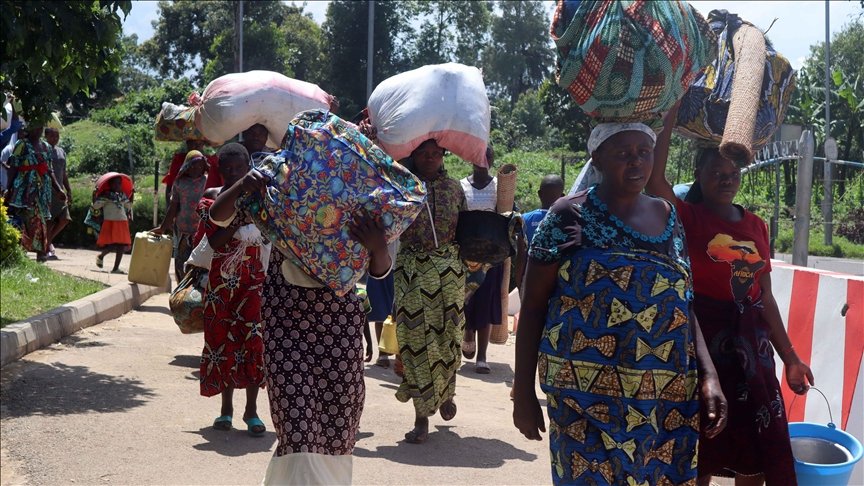
The government of the Democratic Republic of the Congo (DRC) has announced plans to receive, starting in April 2026, third-country nationals expelled from the United States. The decision follows an agreement reached with Washington as part of U.S. migration management mechanisms.
Presented as a temporary measure, the arrangement does not specify the number of individuals involved. Authorities in Kinshasa insist that the operation will be fully funded by the United States, with no impact on the Congolese public treasury.
However, civil society groups have voiced strong opposition, warning of risks in a country already facing major security challenges and hosting millions of internally displaced people.
According to details provided by sources in Kinshasa, the mechanism предусматриes the supervised reception of migrants expelled from the U.S., under terms jointly defined by Congolese and American authorities. The government stressed that this is neither a permanent resettlement program nor an outsourcing of U.S. migration policy. The stay of those concerned is expected to be strictly temporary.
Each case will be reviewed individually, in line with Congolese law and national security requirements, officials said. No automatic transfers will be allowed. Reception sites have already been identified in the outskirts of Kinshasa.
Key questions remain unanswered, including how many migrants will be affected, when they will arrive, and what the DRC will receive in return. No official clarification has been provided. Sources also indicate that this migration deal is separate from the strategic partnership agreement signed between Kinshasa and Washington last December, with negotiations reportedly beginning afterward.
Civil Society Raises Concerns
Congolese civil society remains unconvinced. Timothée Mbuya of the NGO Justicia ASBL criticized what he described as a lack of transparency surrounding the agreement.
“Neither the Congolese population, nor members of parliament or the Senate, were informed. There has been no public debate. The Congo is not a dumping ground for individuals rejected by other countries. Our country lacks the infrastructure to accommodate such people.”
Other civil society actors argue that priority should instead be given to addressing the needs of more than six million internally displaced Congolese citizens.
A Broader Migration Strategy Under Scrutiny
While the official statement does not mention any direct compensation, the agreement comes amid strengthening cooperation between the DRC and the United States. This includes economic ties—such as a minerals-for-security deal—and health sector support, with Washington pledging $900 million.
To understand the broader context, observers point to similar arrangements elsewhere. In February 2026, the Democratic minority in the U.S. Senate published a report on agreements involving the transfer of migrants to third countries. According to the document, more than $32 million was paid to five countries—Rwanda, Equatorial Guinea, El Salvador, Eswatini and Palau—to host around 300 migrants.
The report highlights a pattern of opaque agreements with governments that have faced criticism over human rights records.
According to diplomatic sources cited in the report, countries targeted by Washington tend to share common characteristics: low levels of development, limited institutional protections, and relative isolation—factors that may facilitate the swift conclusion of discreet agreements.
On the objectives behind these policies, the Senate report quotes U.S. officials as openly describing a strategy of deterrence: discouraging potential migrants, pushing them to abandon asylum claims, or even prompting voluntary return.
The Democratic minority concludes that the mechanism serves primarily a political messaging purpose rather than a coherent migration policy—claims that the Trump administration disputes. For its part, the DRC has not commented on these criticisms.











Leave a comment