

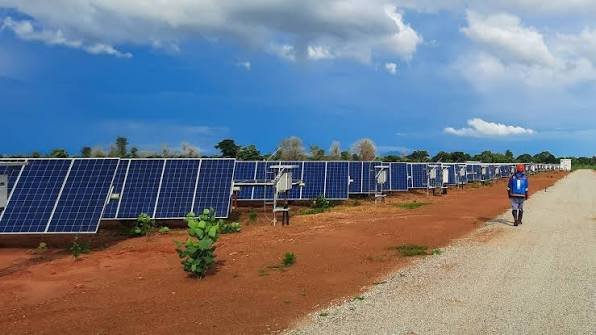
US President Donald Trump continues to push for greater oil production under his “Drill, baby, drill” slogan. But in Africa, rising fuel prices and the rapid expansion of Chinese solar technologies could reshape the continent’s energy market. The battle for Africa’s energy future is increasingly being fought on price. And in that competition, oil could gradually lose ground to cheaper Chinese solar technologies.
Chinese solar technology drives Africa’s energy transition
Africa’s solar power capacity jumped by 54% in 2025, adding around 4.5 gigawatts of new capacity. The growth has been largely driven by falling prices for solar panels and batteries manufactured in China.
For many African countries, the equation is straightforward: reduce dependence on imported oil while expanding access to electricity.
China’s increasingly affordable solar equipment is making that transition more financially accessible, particularly in countries where electricity grids remain unreliable and fuel costs are high.
Nigeria illustrates the challenge. The country’s power grid supplies electricity for only around seven hours a day on average, while an estimated 22 million generators run on diesel or petrol.
The annual cost of operating those generators is estimated at around $12 billion, making cheaper solar systems an increasingly attractive alternative — both economically and environmentally.
China exports more than solar panels
Beijing’s role in Africa’s energy transition goes beyond the export of equipment.
Chinese companies and financial institutions are also involved in the construction and financing of hydropower dams, wind farms and solar power plants across the continent, from Egypt to South Africa.
Morocco has also attracted Chinese investment in battery manufacturing, particularly for the electric vehicle industry.
This combination of equipment, infrastructure and financing is giving China a growing role in Africa’s energy transformation.
A challenge for Washington
The shift creates an unusual strategic dilemma for the United States.
While Trump is seeking to boost oil production and maintain the importance of hydrocarbons in the global energy system, China is helping African countries develop technologies and infrastructure that could allow them to consume less oil.
If the trend accelerates, growing solar capacity, battery storage and electric mobility could gradually weaken demand for petroleum products in some African markets.
That could eventually add pressure to global oil markets, particularly if production continues to rise faster than demand.
For Africa, however, the immediate priority is less about geopolitics than affordability: securing reliable electricity at a price households and businesses can afford. And on that front, Chinese solar technology is becoming increasingly difficult to ignore.









Leave a comment