

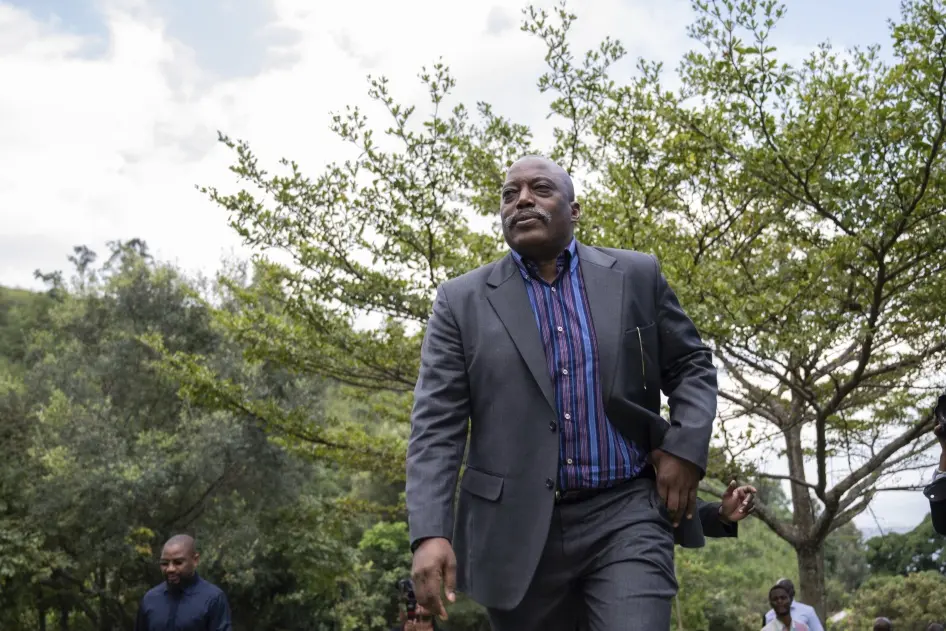
After sanctioning the Rwandan army over its alleged support for AFC/M23 rebels, Washington has now targeted former Congolese President Joseph Kabila for what it describes as attempts to destabilize the government in Kinshasa.
On April 30, the United States imposed sanctions on Kabila, accusing him of “fueling instability” in the Democratic Republic of Congo (DRC) through his support for the M23 armed group, according to an official source cited by AFP. The former president (2001–2019) has been added to the U.S. government’s sanctions list managed by the Office of Foreign Assets Control (OFAC).
Washington believes that the former leader is seeking to “destabilize the government of the DRC by supporting the M23 and the AFC,” its political wing, according to a statement reviewed in advance by AFP. The OFAC also noted that Kabila “lived under the protection of the M23” last year in Goma, a stronghold of the armed group in eastern DRC.
The U.S. sanctions include the freezing of any assets Kabila may hold in the United States and prohibit American companies and citizens from engaging in business dealings with him.
“This is only a logical consequence, even if it took time,” said Interior Minister Jacquemain Shabani, as quoted by Jeune Afrique. “Joseph Kabila is the instigator, initiator, and architect of the destabilization of Congo.” In late September 2025, the Congolese judiciary sentenced him to death in absentia for “complicity” with the M23, which is allegedly supported by Rwanda.
A few weeks later, Kigali and Kinshasa signed a fragile peace agreement in Washington under the auspices of U.S. President Donald Trump. “President Trump is working toward peace in the Democratic Republic of Congo and has made it clear that those who continue to fuel instability will be held accountable,” said U.S. Treasury Secretary Scott Bessent, who oversees OFAC, in the statement.
Rising U.S. Pressure
Earlier in 2025, M23 fighters and their allies seized the major Congolese cities of Goma and Bukavu in a rapid offensive that overwhelmed government forces. In early December, the group also captured Uvira, a strategic city near the Burundian border, just days after the Washington agreements were signed, before withdrawing under U.S. pressure.
The United States has recently imposed sanctions on the Rwandan army over its support for the armed group, sparking anger in Kigali.


Leave a comment