

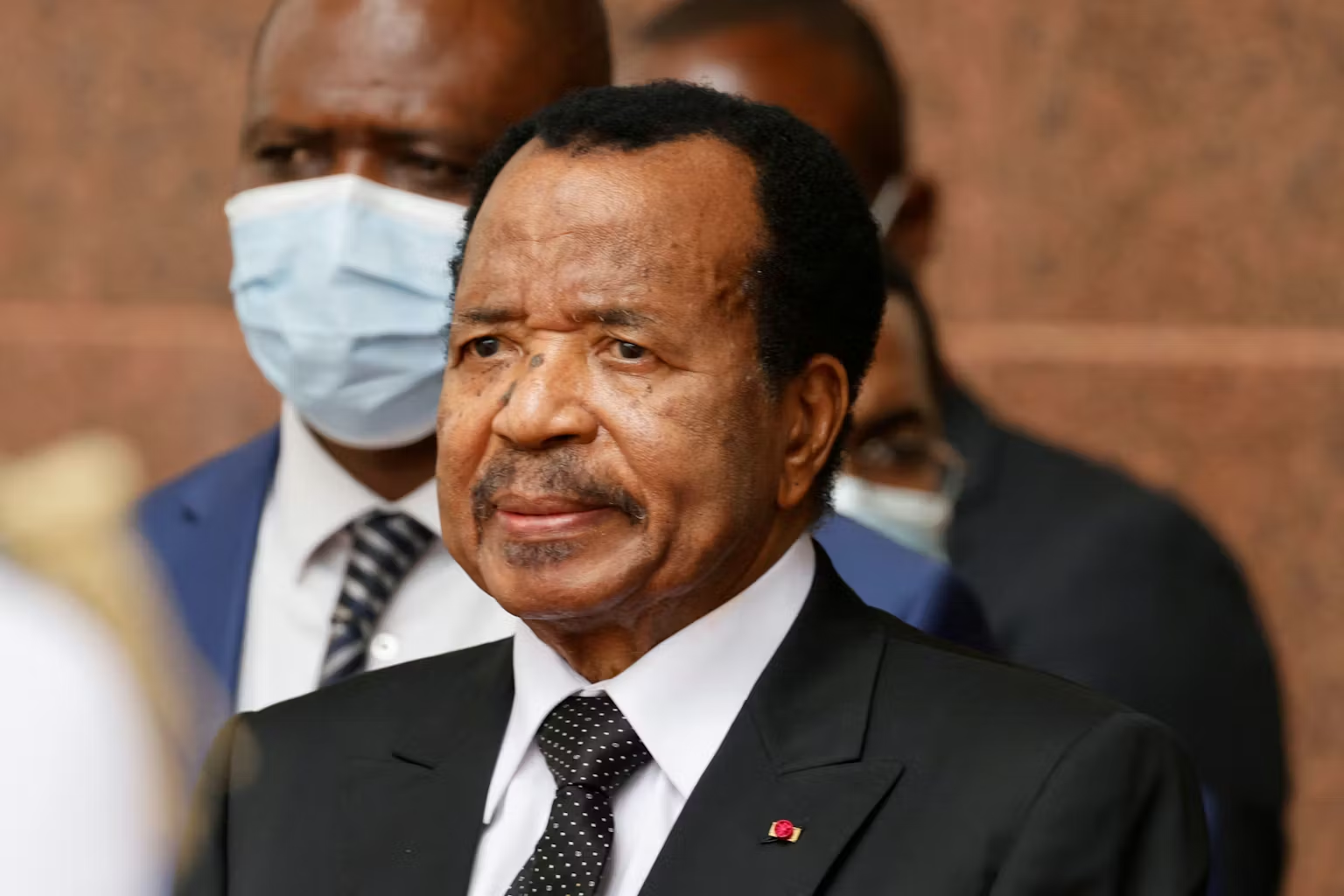
On Saturday, April 4, the Cameroonian Parliament, sitting in Congress, approved a constitutional revision establishing the office of Vice-President. The new role designates the vice-president as the constitutional successor to the president, automatically assuming the presidency in the event of death, resignation, or permanent incapacity of the head of state.
The reform marks a major turning point in Cameroon’s political landscape. Observers note that it clarifies, regardless of political affiliation, the contours of power succession at the highest level. For the first time, discussions about the “post-Biya” era are no longer taboo, including the possibility that President Paul Biya may not complete his current seven-year term.
Context: From Censorship to Constitutional Reform
In 2024, debates over President Biya’s health were strictly prohibited by the Minister of Territorial Administration, Paul Atanga Nji. Today, pro-government political analyst Mathias Eric Owona Nguini frames the constitutional revision as a response to controversies surrounding the October 2025 presidential election and the feasibility of an eighth term for a 93-year-old president.
“Through this reform, President Paul Biya and his governing order address concerns of both Cameroonians and foreigners about the need for a predictable constitutional framework that ensures the stability and continuity of the state if the president can no longer exercise his functions,” Owona Nguini said.
Elections Could Be Postponed
Under the revised Constitution, the vice-president would automatically assume the presidency for the remainder of the term, until 2032, without the need for an immediate election.
President Biya had not formally announced this revision during his campaign or at his inauguration, nor in his speeches prior to December 31, when he only mentioned a “new government” forthcoming “in the coming days.”
Civil society representative Hilaire Kamga argues that the move reflects the ruling party’s strategy to minimize electoral competition:
“They have addressed an issue in line with their aim to perpetuate power, ensuring the same regime remains. It’s a case-by-case management, waiting to see how the RDPC organizes to maintain control, despite growing demands.”
Already postponed legislative elections are now scheduled for 2027, while municipal elections could also be delayed, as revisions to the electoral code remove limits on extending local officials’ terms.
Succession and Governance Challenges
The constitutional revision grants President Biya sole authority to appoint his vice-president, raising concerns over democratic accountability.
Economist Dieudonné Essomba highlights how the reform attempts to address governance gaps left by Biya’s decreased public presence:
“Since the president has become less active, there has been significant uncertainty. Instructions issued in his name are often not taken seriously. Regarding succession, the system is extremely tense, and the vice-president role could potentially reduce volatility.”
Essomba also notes that a vice-president could play a key role in addressing economic challenges, including a potential austerity plan, as well as the ongoing eight-year conflict in the North-West and South-West anglophone regions.
Looking Ahead
The constitutional revision represents a strategic recalibration of power in Cameroon, balancing political continuity with the growing need for governance predictability. While critics question its democratic legitimacy, the move clearly signals that discussions about the post-Biya era and presidential succession are now part of Cameroon’s political discourse.







Leave a comment