


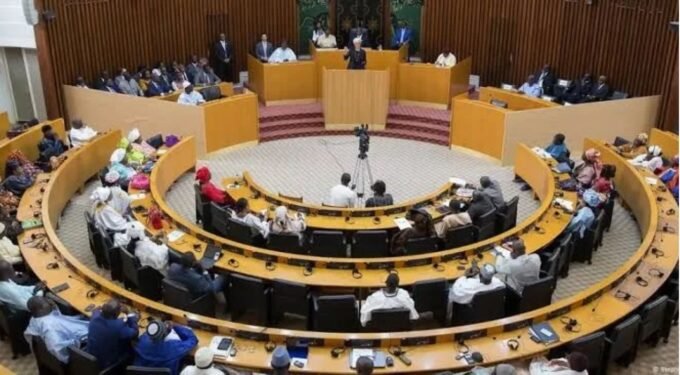
The standoff between Senegal’s executive branch and the parliamentary majority over the 2026 amended budget is continuing. On Wednesday, 25 November, the National Assembly adopted a resolution challenging the presidential decree that brought the budget into force after lawmakers had rejected it. The move marks a new stage in institutional tensions as the country continues discussions with the International Monetary Fund (IMF).
The resolution was adopted by 128 votes in favour, nine against and two abstentions, out of 139 votes cast. Put forward by the Pastef parliamentary group, which holds a majority in the National Assembly, it challenges President Bassirou Diomaye Faye’s decision to enact the 2026 amended finance bill by decree.
Lawmakers had rejected the budget bill on 3 November. However, on 19 November, the head of state signed Decree No. 2026-2416 to bring it into force. Following the Council of Ministers meeting on 25 November, he instructed the Prime Minister and the minister responsible for finance to take the necessary steps to implement it “without delay”.
Pastef denounces violation of parliamentary powers
For majority lawmakers, resorting to a decree after parliament rejected the bill undermines the National Assembly’s constitutional powers. Pastef parliamentary group leader Ayib Daffé considers the decision illegal and unconstitutional and is calling for its immediate withdrawal.
The resolution adopted by MPs is intended to reaffirm the authority of the parliamentary vote and highlight the requirements of the separation of powers. It also raises the issue of potential responsibility for public officials tasked with implementing the budget.
The government, for its part, justifies its decision by citing Article 68, paragraph 5, of the Constitution. According to the executive’s argument, this provision allows a finance bill to be enacted by decree when the constitutional 60-day deadline has elapsed without its final adoption. The interpretation of this provision is precisely one of the main points of disagreement between the two institutions.
Opposition calls for legal action
Within the opposition, Abdou Mbow, an MP from the Takku Wallu parliamentary group, believes the resolution will not resolve the dispute. Instead, he is urging Pastef lawmakers to take the matter to the competent courts to challenge the decree.
He also believes the political confrontation could complicate discussions with the IMF. The lawmaker is calling for legal avenues to be prioritised over further institutional escalation.
However, the parliamentary resolution does not, in itself, annul the presidential decree. The dispute could therefore continue through the legal system if MPs decide to refer the matter to the relevant authorities.
IMF talks in the background
The controversy comes as Senegal continues negotiations with the International Monetary Fund. On 1 September 2026, IMF staff and Senegalese authorities reached a preliminary agreement on a $2.2 billion aid programme over 36 months. The agreement is still subject to approval by the institution’s Executive Board.
The amended finance bill is an important part of discussions on restoring public finances and controlling debt. The government considers its adoption a necessary step towards continuing economic and financial reforms.
Amid parliamentary opposition, disagreements over the interpretation of the Constitution and negotiations with financial partners, the 2026 amended budget remains at the centre of Senegal’s political tensions.












Leave a comment