

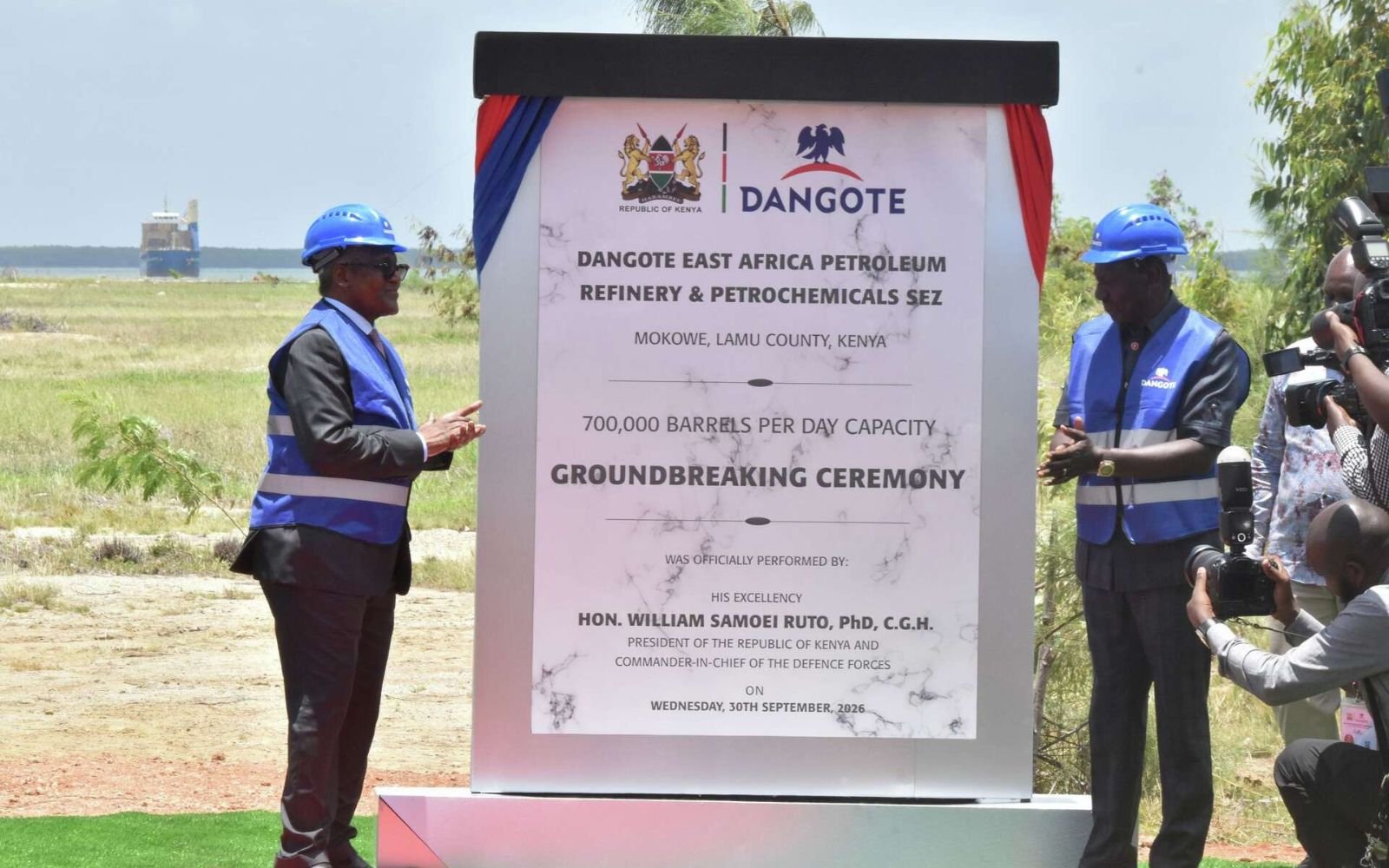
Nigerian billionaire Aliko Dangote on Wednesday launched preparatory work on a planned 700,000-barrel-per-day refinery in Lamu, Kenya. Presented as a major African industrialisation project, the $16 billion investment has also raised environmental concerns.
The Dangote Group laid the foundation stone for the future refinery on Kenya’s coast, near the deep-water port of Lamu. The project, estimated at $16 billion, is expected to reach a processing capacity of 700,000 barrels of crude oil per day, which its promoter says would exceed the capacity of any refinery currently operating in Europe.
The groundbreaking ceremony was attended by Kenyan President William Ruto, Ethiopian Prime Minister Abiy Ahmed and Ugandan President Yoweri Museveni.
“Today, we are not just laying the foundation stone of a refinery, but of a new chapter in Africa’s industrial history,” Dangote said during the ceremony.
The project is also expected to include a 1,000-megawatt power plant, with half of its output earmarked for Kenya’s electricity grid. In its initial phase, the crude needed to operate the refinery would be imported from several regions outside Africa, as production capacity in Kenya and neighbouring countries remains insufficient.
Reducing reliance on fuel imports
Dangote says the refinery should help reduce Africa’s dependence on imported refined petroleum products. According to the Africa Finance Corporation, the continent currently imports around 70% of the fuel it consumes, despite producing several million barrels of crude oil each day.
The Dangote Group already operates a 650,000-barrel-per-day refinery in Nigeria, which began operations in 2024. Its capacity could eventually rise to 1.4 million barrels per day by 2028, potentially placing it among the world’s largest refining facilities.
The Kenyan project, however, has not received unanimous support. Environmental organisations, including Greenpeace, have raised concerns about the potential impact on what they describe as a fragile ecosystem around Lamu.
Dangote has defended the project as part of a broader effort to build an industrial ecosystem around refining capacity. He argues that Africa needs to expand its refining infrastructure in order to process more of its natural resources locally and reduce reliance on foreign companies for major industrial projects.
The Lamu refinery is therefore being presented as both an industrial investment and part of a wider push to increase Africa’s capacity to transform its own raw materials into higher-value products.












Leave a comment