

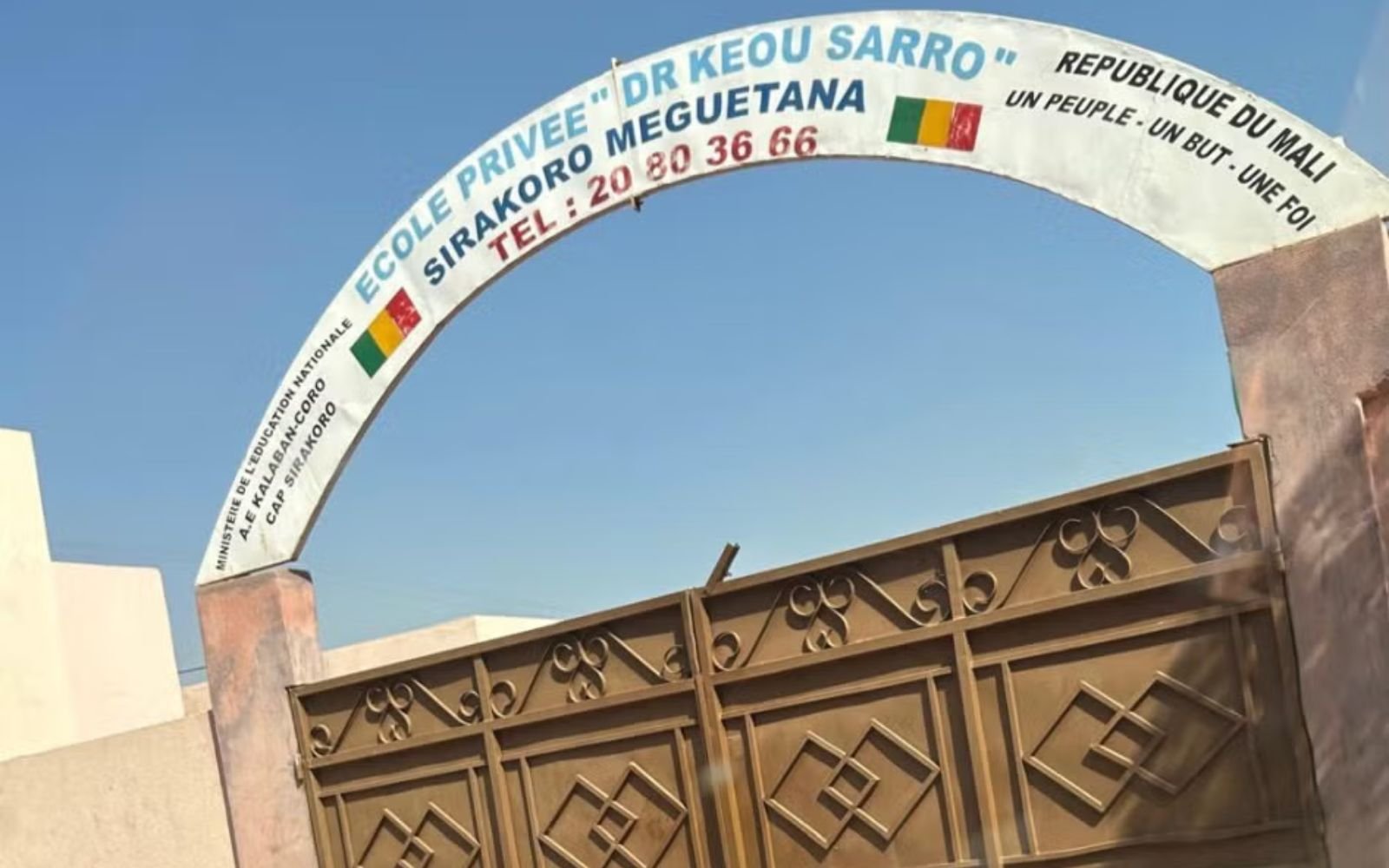
Schools reopened across Mali on Thursday, October 1, as the 2026-2027 academic year was declared the “Year of Education and Culture” by transitional President General Assimi Goïta. But deteriorating security conditions and the growing presence of jihadist groups mean that more than 2,400 schools will remain closed, affecting hundreds of thousands of children.
A total of 2,444 schools out of 11,860 nationwide are currently closed, meaning that more than one in five schools cannot receive students, according to figures published in June by Mali’s Education Cluster, which brings together the Education Ministry and organisations working in the sector.
The closures affect approximately 733,200 children.
Schools have been forced to shut for several reasons. Some have been ordered to close by jihadist groups, while others have been looted or destroyed during attacks. In some areas, teachers are too afraid to take up their posts. Other schools are being used to accommodate families displaced by violence.
The number of closed schools has increased steadily in recent years. Around 1,300 schools were closed in 2020, compared with 1,800 in 2024 and more than 2,400 this year.
Northern regions particularly affected
Two weeks before the start of the school year, education-sector unions raised concerns during a meeting at the Education Ministry, particularly over the number of closed schools and the situation of teachers working in Ménaka and Kidal, in northern Mali.
The separatist FLA and the jihadist Group for the Support of Islam and Muslims (JNIM), linked to al-Qaeda, took control of Kidal and Tessalit on April 25, according to the source. The Malian army and state administration were subsequently pushed out, while 84% of schools in the region are now closed.
In Ménaka, Malian forces still control the city itself, while much of the surrounding region has been under the influence of the Islamic State’s Sahel branch for several years.
As a result, 52% of schools in the Ménaka education district are classified as non-operational.
Central Mali also heavily affected
The situation is only slightly better in central Mali, where JNIM’s Macina Katiba maintains a presence in numerous villages and rural areas.
School closures reach 38% in the Bandiagara education district, 52% in Douentza and 68% in Tenenkou, highlighting the scale of the disruption caused by insecurity.
The closures come as the transitional authorities have placed education and culture among their stated priorities. During last week’s Independence Day celebrations, General Assimi Goïta recalled his decision to designate 2026-2027 as the “Year of Education and Culture.”
The contrast between that ambition and the continuing disruption caused by insecurity illustrates one of the major challenges facing Mali’s education system as the new academic year begins.







Leave a comment