

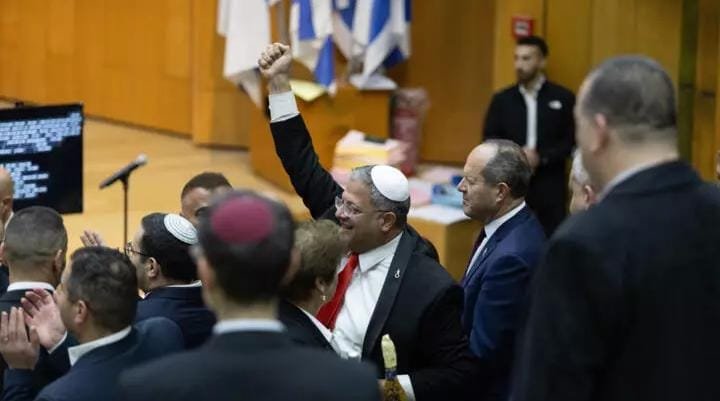
The Knesset’s vote to establish capital punishment by hanging for those convicted of terrorist acts marks a historic and controversial turning point in Israel. While far-right ministers celebrate the decision, NGOs and human rights advocates denounce the law as « discriminatory » and part of a « racist agenda » specifically targeting Palestinians.
After twelve hours of heated debate, the verdict was reached on Monday night: 62 lawmakers voted in favor of the law, with 48 against. The text stipulates that the death penalty will be imposed on any « terrorist » who has killed an individual with the intent of « denying the existence of the State of Israel. »
While the government presents this measure as a security necessity, champagne celebrations by far-right ministers have shocked both the opposition and civil society. For many, this law is not a simple judicial measure but a political tool targeting a specific community.
The text has faced sharp criticism from human rights organizations. According to Yair Dvir, spokesperson for the Israeli NGO B’Tselem, the wording of the law leaves no room for doubt:
« The bill is deliberately drafted and designed to be applied exclusively to Palestinians, explicitly exempting Israeli citizens and residents. »
Miriam Azem, advocacy director for the NGO Adalah, echoed this sentiment, describing it as a « natural escalation » of a system that has systematically targeted Palestinians for two decades. She characterized it as a « racist and violent agenda » that is now institutionalized at the highest levels of the state.
Several petitions have already been filed with the Supreme Court. The legal stakes are significant: Shawan Jabarin, director of the Palestinian organization Al Haq, asserts that the text violates international standards regarding non-discrimination.
Parliament’s own legal advisors have warned that the text could breach international treaties.
Amjad Chihab, a political analyst, highlights the lack of sufficient guarantees for a fair trial and the absence of a real possibility for appeal.
Tirza Leibovitz of Physicians for Human Rights Israel pointed out that this law goes against the global trend toward abolition, describing the situation as « a step back by several decades. » Beyond the political sphere, the law is deeply dividing the population. While some, traumatized by the events of October 7, remain hesitant about the path forward, others are expressing horror.
Roni, a young reservist, did not hide her despair: « I have no words; I think it’s horrifying. It feels like the end of the country… It doesn’t represent who we are. » To her, the text is the work of a « handful of bloodthirsty extremists. » Conversely, citizens like Odaya reflect a persistent moral confusion—a sign of a youth searching for direction under a government they feel has « lost its way. »The fate of this law now rests in the hands of the High Court of Justice, which must rule on the constitutionality of a text that, even before its implementation, is already tearing at the country’s social and judicial fabric.
Secondine GOZINGAN










Leave a comment