

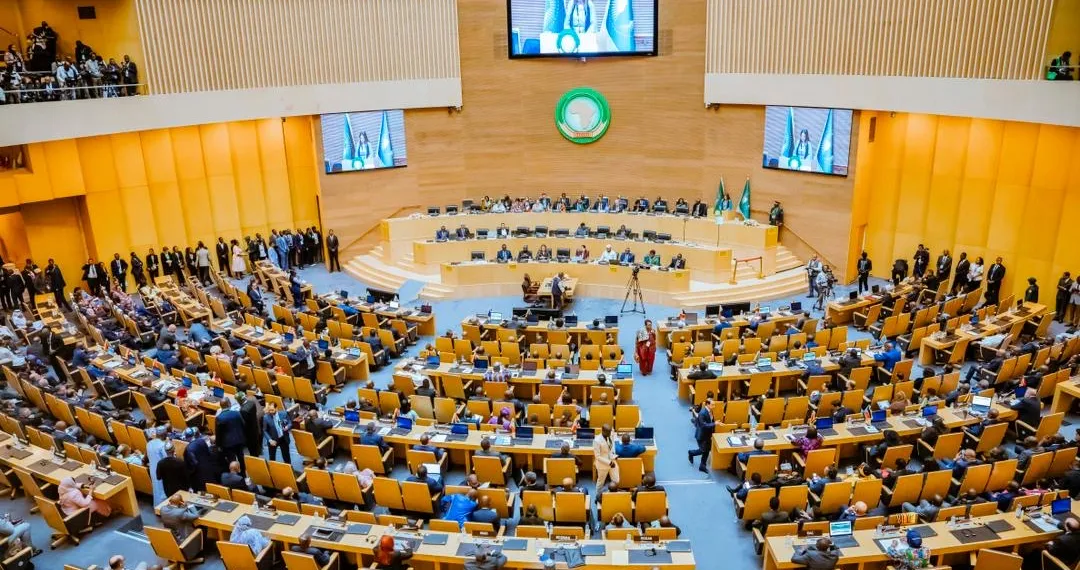
Since its establishment in 2002, replacing the Organisation of African Unity, the African Union has sought to reposition the continent within a rapidly changing global order. Its mandate is ambitious: promote unity, safeguard sovereignty, prevent conflict, accelerate economic integration, and strengthen Africa’s voice internationally. More than twenty years later, the Union stands at a critical juncture.
Institutional Architecture and Political Authority
The African Union operates through a structured institutional system. The Assembly of Heads of State and Government remains the supreme decision-making body. The Peace and Security Council oversees conflict prevention and crisis management. The African Commission manages administrative coordination, while the Pan African Parliament and the African Court on Human and Peoples’ Rights contribute to governance and accountability frameworks.
One of the AU’s most significant innovations has been its principle of non indifference. Unlike its predecessor, the Union can intervene in member states in cases of war crimes, genocide, or unconstitutional changes of government. This principle has been invoked during crises in countries such as Mali, Guinea, and Sudan, where suspensions were imposed following military takeovers.
However, enforcement capacity remains uneven. The AU’s influence often depends on diplomatic persuasion rather than coercive mechanisms. Its authority ultimately rests on the political will of sovereign states.
Security and the Sahel Challenge
Security remains the AU’s most visible test. The Sahel region has experienced persistent instability driven by armed insurgencies, cross border trafficking networks, and fragile state institutions. Regional coordination mechanisms have evolved, yet results remain mixed.
AU backed missions, often supported logistically and financially by international partners, illustrate both the Union’s operational engagement and its financial constraints. Sustainable peace in the Sahel requires not only military responses but structural investment in governance, education, and employment for a rapidly growing youth population.
Financing Reform and Autonomy
A major structural debate concerns financial independence. Historically, a substantial portion of AU program funding has relied on external partners. To address this, member states adopted a 0.2 percent levy on eligible imports to finance the Union’s activities. Implementation has progressed but remains inconsistent across countries.
Without predictable internal funding, the AU’s strategic autonomy remains limited. Reform discussions initiated through the Kigali institutional reform process have sought to streamline organs, reduce duplication, and improve accountability.
AfCFTA and the Integration Imperative
The African Continental Free Trade Area, operational since 2021, represents the most ambitious economic integration effort in the continent’s history. With nearly all AU member states participating, the agreement aims to create the largest free trade area in the world by number of countries.
According to World Bank projections, the agreement could significantly boost intra African trade and reduce extreme poverty if fully implemented. However, tariff schedules, customs harmonization, and infrastructure deficits remain practical hurdles.
The AU’s future credibility may depend less on diplomatic declarations and more on measurable integration outcomes. The coming decade will determine whether the Union evolves into a decisive supranational actor or remains a coordination platform constrained by national interests.











Leave a comment